
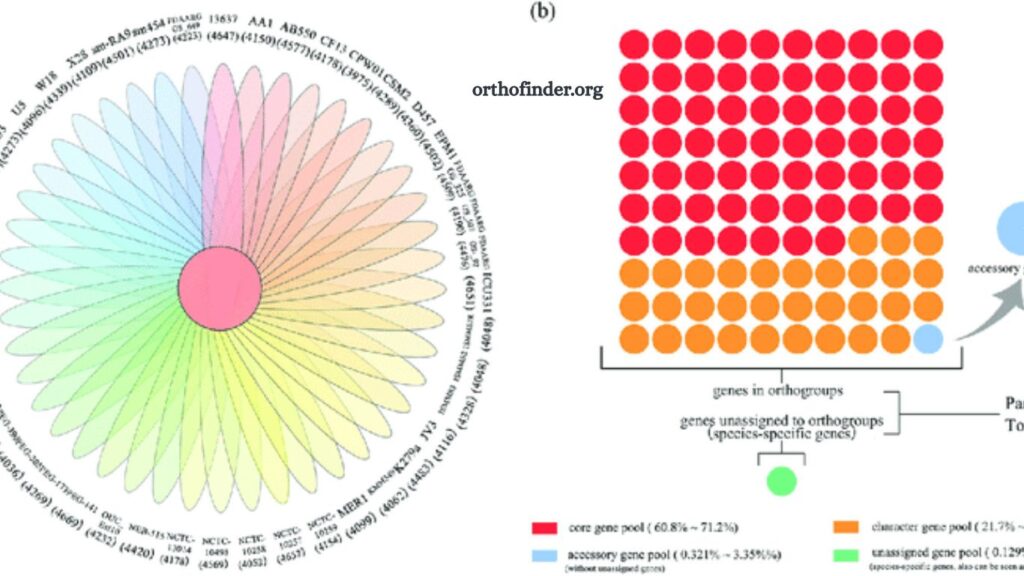
Comparative genomics depends on accurate identification of gene relationships across species to uncover evolutionary patterns, functional similarities, and biological mechanisms. Among the available tools, OrthoFinder has become a widely adopted solution for orthology inference due to its high accuracy, speed, and scalability. Researchers rely on it to analyze large genomic datasets and extract meaningful evolutionary insights with improved confidence.
This article explains the major advantages of OrthoFinder in comparative genomics and why it continues to play a central role in modern bioinformatics workflows.
High Accuracy in Ortholog Detection
OrthoFinder delivers highly reliable ortholog predictions by using a graph-based clustering approach combined with phylogenetic methods. Many traditional tools rely solely on sequence similarity, which often leads to false positives or incorrect groupings.
OrthoFinder improves accuracy by:
- Inferring gene trees for orthogroups
- Reconstructing species trees internally
- Resolving duplication and speciation events
This integrated strategy ensures that orthologs and paralogs are distinguished more precisely. Researchers gain more confidence in downstream analyses such as gene function prediction and evolutionary reconstruction.
Read More: Common OrthoFinder Errors and How to Fix Them
Automated and Fully Integrated Workflow
Comparative genomics studies often require multiple tools for clustering, alignment, tree building, and species inference. OrthoFinder simplifies this process by providing a fully automated pipeline.
Key workflow benefits include:
- Direct input of protein sequences without manual preprocessing
- Automatic orthogroup construction
- Built-in species tree inference
- Gene tree reconciliation for evolutionary insights
This automation reduces dependency on external tools and minimizes human error, making large-scale genomic studies more efficient and reproducible.
Scalability for Large Genomic Datasets
Modern genomic research involves hundreds or even thousands of species. Many older orthology tools struggle with such a scale due to computational limitations.
OrthoFinder handles large datasets effectively by:
- Using efficient clustering algorithms
- Parallelizing computational tasks
- Optimizing memory usage during gene tree construction
Its performance remains stable even with large eukaryotic datasets, making it suitable for pan-genomic and multi-species analyses.
Researchers working on plant genomics, microbial diversity, or evolutionary biology benefit significantly from this scalability.
Improved Species Tree Reconstruction
Accurate estimation of the species tree plays a critical role in comparative genomics. OrthoFinder does not rely on a predefined species tree. Instead, it infers the tree directly from gene data.
This approach provides:
- Reduced bias from incorrect prior assumptions
- More biologically consistent phylogenies
- Better resolution of deep evolutionary relationships
The built-in species tree reconstruction enhances downstream interpretations, especially when studying divergent species or incomplete lineage sorting.
Robust Handling of Gene Duplications
Gene duplication events significantly complicate orthology analysis. Incorrect handling can distort evolutionary interpretations and functional predictions.
OrthoFinder addresses this challenge through:
- Gene tree reconciliation methods
- Identification of duplication and speciation nodes
- Separation of orthologs from paralogs with higher precision
This capability allows researchers to study gene family evolution more accurately and identify functional diversification across species.
High Speed Compared to Traditional Tools
Speed remains a major factor in large-scale genomic analysis. OrthoFinder outperforms many traditional orthology inference tools in computational efficiency.
Performance improvements come from:
- Fast sequence similarity search integration
- Optimized clustering algorithms
- Efficient phylogenetic reconstruction techniques
Even with large datasets, OrthoFinder completes analyses within practical timeframes, supporting iterative research and exploratory studies.
Consistent and Reproducible Results
Reproducibility is essential in computational biology. OrthoFinder produces consistent outputs across runs when using the same input data and parameters.
This consistency is achieved through:
- Deterministic algorithm design
- Standardized gene tree inference methods
- Structured output formats for easy comparison
Researchers benefit from reliable results that support publication-quality analysis and collaborative studies.
Support for Functional Genomics Research
Orthologs often share conserved biological functions across species. OrthoFinder facilitates functional annotation transfer by identifying high-confidence ortholog groups.
Applications include:
- Gene function prediction in non-model organisms
- Identification of conserved pathways
- Cross-species functional comparison
This makes OrthoFinder highly valuable in agricultural genomics, medical research, and evolutionary studies.
Better Handling of Complex Evolutionary Scenarios
Evolutionary processes such as gene loss, duplication, and horizontal transfer introduce complexity into genomic datasets. OrthoFinder incorporates phylogenetic context to manage these challenges more effectively than similarity-only approaches.
It supports:
- Detection of gene duplication history
- Mapping gene gain and loss events
- Reconstruction of evolutionary timelines
These capabilities provide a deeper understanding of genome evolution across diverse lineages.
User-Friendly Design and Accessibility
Ease of use significantly influences adoption in bioinformatics. OrthoFinder offers a straightforward command-line interface that requires minimal configuration.
User-friendly advantages include:
- Simple installation process
- Minimal parameter tuning
- Clear and structured output files
Even researchers with limited computational experience can run full comparative genomics analyses without extensive setup.
Integration with Downstream Bioinformatics Tools
OrthoFinder outputs are compatible with many downstream applications used in genomics research. This interoperability enhances its practical value.
Common integrations include:
- Phylogenetic tree visualization tools
- Gene family evolution analysis pipelines
- Functional enrichment analysis software
This flexibility allows seamless transition from orthology inference to biological interpretation.
Reduced Dependency on External Databases
Unlike some orthology tools that rely heavily on external reference databases, OrthoFinder primarily operates on user-provided protein sequences.
This design provides:
- Independence from database updates
- Greater control over input datasets
- Reduced bias from external annotations
Researchers maintain full control over analysis conditions, improving transparency and reproducibility.
Strong Community Support and Continuous Updates
Active development and a strong research community contribute to OrthoFinder’s reliability and relevance in modern genomics.
Benefits include:
- Regular software updates
- Active issue resolution
- Strong documentation and tutorials
- Wide adoption in peer-reviewed research
This support ecosystem ensures long-term usability in evolving bioinformatics environments.
Frequently Asked Questions
What is OrthoFinder used for in comparative genomics?
OrthoFinder is used to identify orthologous genes across multiple species, helping researchers study evolutionary relationships and gene function.
Why is OrthoFinder preferred over other orthology tools?
OrthoFinder provides higher accuracy, automated workflows, and better handling of gene duplications compared to many traditional tools.
Does OrthoFinder require a reference genome?
No, OrthoFinder works directly with protein sequence data and does not depend on a predefined reference genome.
How does OrthoFinder improve evolutionary analysis?
It reconstructs gene trees and species trees, allowing more accurate interpretation of evolutionary events such as duplication and speciation.
Can OrthoFinder handle large genomic datasets?
Yes, it is designed for scalability and can efficiently process hundreds or even thousands of species.
Is OrthoFinder suitable for beginners in bioinformatics?
Yes, it offers a simple command-line interface and automated workflow, making it accessible for both beginners and advanced users.
What kind of results does OrthoFinder produce?
It generates orthogroups, gene trees, species trees, and detailed orthology relationships for downstream genomic analysis.
Conclusion
OrthoFinder strengthens comparative genomics by delivering accurate ortholog identification, automated analysis, and scalable performance for large datasets. Its ability to reconstruct gene and species trees enhances evolutionary interpretation and supports reliable functional insights across diverse organisms. Researchers gain a streamlined workflow that reduces complexity while improving precision in genomic studies.